On the front page
Generative AI under the environmental microscope: PEReN contributes to the Arcep report
How much energy do generative AI models actually consume? PEReN conducted a groundbreaking study for Arcep, measuring the energy consumption of 22 text-generation models during operation. The results, which are fully available to the public, shed light on some of the issues raised in the report “Generative Artificial Intelligence, What Are the Environmental Challenges?”, published by Arcep.
Published on May 21, 2026

Renaud Labelle Appointed Director of PEReN
A graduate of École Polytechnique (1997) and Télécom Paris (1999), Renaud Labelle, an Ingénieur Général des Mines, has been appointed director of PEReN.
Published on Mar 30, 2026

Shedding light on... No. 10 - An exploration of the engaging features of digital platforms
Digital platforms, particularly social networks, use mechanisms designed to maximize user attention, with risks to their well-being, especially that of minors. At the request of the DGMIC and as part of the REN, PEReN conducted a technical study to characterize these engaging features and inform regulators about the configuration options available for safer use by minors. The results are detailed in this 10th issue of Éclairage sur.
Published on Jan 14, 2026

INESIA - Results of an AI agent evaluation exercise by the International Network of AI Safety Institutes
As part of the International Network of AI Safety Institutes, INESIA, including PEReN, has taken part in a new joint exercise on the evaluation of AI agents.
Published on Jul 30, 2025
PEReN 2024 activity report
PEReN has submitted its activity report for 2024 to its three supervisory ministers (Economy, Digital, Communication). A look back at a year rich in technical support for the regulation of digital platforms.
Published on Jul 29, 2025

Opt-out protocols: a presentation to help you better understand the issues at stake
The breakthrough of generative AI has brought to light new issues surrounding the automated collection of content from websites, particularly press websites. At the request of the Ministry of Culture, PEReN is publishing an inventory of opt-out protocols, or reservation of rights, which was carried out in 2024 for its Directorate-General for Media and Cultural Industries (DGMIC).
Published on Jul 21, 2025
INESIA - Results of joint testing for the improvement of LLM multilingual evaluation methodologies
Within the framework of the international network of AI safety institutes, PEReN, through INESIA, took part in a joint testing exercise for the improvement of LLM multilingual evaluation methodologies. Publication of the results evaluation report.
Published on Jul 08, 2025

PANAME: a partnership for privacy auditing of AI models
CNIL, ANSSI, PEReN and the IPoP project of PEPR Cybersecurity are launching PANAME, a project aimed at developing a tool for auditing the privacy of AI models.
Published on Jun 26, 2025

Generated and original content: an example of an approach for identifying their similarity in a dataset of artistic images
The rise of generative AI has led to the usage of millions of original images to generate new ones. In this context, identifying which specific original works were used to produce a particular artificial image is not only very costly in terms of computational power but also uncertain. PEReN explores an alternative approach in this prototype, based on the nearest neighbors search method, which allows for a low-cost identification of the images in the training set that are most similar to a generated image. Although imperfect, this approach provides a method for objective comparisons, serving as a basis for subsequent discussion.
Published on May 16, 2025

Detecting artificial content on social networks: a tool for knowing which detectors to trust
Generated content proliferates online, and the ability to detect it is now a major challenge to guarantee trust in AI and in information integrity. But it’s not an easy task! PEReN and Viginum set out to evaluate the performance and robustness to typical transformations observed on social networks of a set of detection models. Let’s dive in this open-source software.
Published on Feb 11, 2025

AI Action Summit 2025: PEReN and Viginum open collaborative artificial content meta-detector project
With the AI Action Summit just a month away, PEReN and Viginum are inviting researchers and experts to participate in the development of a digital commons consisting of a meta-detector for artificial content. Based on an open-source architecture, the tool uses a collection of state-of-the-art detectors.
Published on Jan 10, 2025
Shedding light on…n°9 - « Opening up » social networks: 4 leads in 5 questions
Based on advertising revenues, the economic model of the vast majority of social networks aims to maximize user time. With little control over the technological levers used by users, some are calling for social networks to be "opened up", to "give users back the choice". What impact might this have on users and platforms? This issue 9 of "Shedding light on..." takes stock.
Published on Dec 19, 2024

What are the risks and limits of generating convincing deepfakes?
The dazzling innovations in AI now make it possible for anyone to create deepfakes. But how easy is it to produce realistic images using the technologies available? In partnership with the CNIL, PEReN has carried out the following study.
Published on Dec 03, 2024

GenAI model comparator: a clearer view of compliance with open source criteria
The OSI has just published a strict definition, in line with its standards, of the notion of open source applied to AI. How do the most widespread models, or those associated with specific licenses, meet this definition? Find out with the PEReN comparison tool!
Published on Oct 29, 2024

Mobility platform workers: PEReN contributes to ARPE's 2023 study
Subject to an obligation of transparency, mobility platforms publish indicators every year on the activity of workers on delivery or ride-hailing services platforms. For the 2023 edition of the ARPE report, PEReN is renewing its contribution to the analysis of these data.
Published on Oct 11, 2024

Technical support for the regulation of digital platforms, PEReN presents its 2023 activity report
PEReN has submitted its activity report for 2023 to its three supervisory ministers (Economy, Digital, Communication). We look back on a year rich in technical support for the regulation of digital platforms.
Published on Jul 29, 2024
Evaluation of the Culture pass, PEReN provides IGAC with its expertise in algorithmic systems
On July 16, the IGAC published its conclusions on the impacts of the individual share of the Culture pass on the intensification and diversification of young people's cultural practices. A look back at PEReN's technical support for this study.
Published on Jul 22, 2024

Shedding light on…n°8 - Privacy Sandbox: a collection of tools for third-party cookieless online advertising (update)
The online advertising ecosystem largely relies on the use of third-party cookies to improve ad relevance. Wishing to offer a technological alternative to the current system, deemed too intrusive, Google launched its Privacy Sandbox initiative in 2019. In this latest instalment of "Shedding light on...", PEReN updates its analysis of the technical and economic stakes of the American giant's solutions.
Published on May 30, 2024

The French mobility orientation law on transport (2019) : an initial analysis of the statistical indicators published by digital labour platforms in France
Subject to an obligation of transparency, digital labour platforms have been publishing indicators on the activity of workers on delivery platforms or ride-hailing services since 2022. PEReN has studied these new data and offers a first unpublished critical analysis.
Published on Apr 25, 2024
Shedding light on…n°7 – Open source and AI: rethinking synergies?
Open source, transparency, openness: these concepts are becoming increasingly commonplace in AI speeches. The unprecedented increase in the capabilities of models, especially generative ones, raises many questions about their training and distribution framework. This new Éclairage sur... explores licensing formats and how they match the needs of stakeholders.
Published on Apr 03, 2024
Governance of digital platforms
PEReN is launching a new web space dedicated to deciphering the actions of digital platforms in terms of transparency. The idea? To offer analytical infographics based on aggregated available resources. Discover them now!
Published on Feb 23, 2024

Hackathon 2024, and the winners are...
Discover the winners of the 2024 hackathon co-organized by PEReN and the European Commission (DG-Connect and ECAT)!
Published on Dec 21, 2023

EGI Agora: PEReN dialogues with citizens
On Wednesday November 29, PEReN took part in the agora of the French government's Information Forum (EGI). This was an opportunity for PEReN to present its work on the generation and distribution of content in the information space in the age of new technologies.
Published on Nov 29, 2023
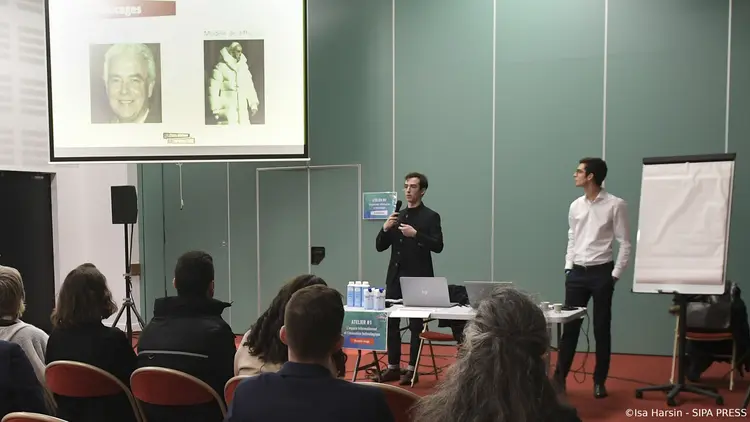
Workshop on data access for research
On October 12, 2023, Arcom and PEReN are organizing a workshop on data access for research. The aim? To enable researchers to discuss the impact of the DSA on their work, to assess whether its implementation would resolve certain difficulties in accessing data for research, and to discuss the process of this access.
Published on Oct 12, 2023

PEReN presents its Activity Report 2022
The Center of expertise for digital platform regulation (PEReN) has submitted its activity report for 2022 to its supervisory ministers (Economy, Culture and Digital).
Published on Jul 28, 2023

DSA Stakeholder Event 2023 : PEReN on hand to help "Shaping the future of digital services"
Invited to the 1st European event on implementation of the Digital Services Act, PEReN took part in two workshops. This was an opportunity for PEReN to present the French response to the European consultation on the implementation of Article 40 (Data access and scrutiny ) of the DSA.
Published on Jun 27, 2023

Shedding light on…n°6 - ChatGPT and the rise of conversational AI models
ChatGPT has put conversational AI models in the spotlight. Capable of conversing with a human being, these technologies raise many questions about their numerous applications. This 6th issue of "Shedding light on..." invites us to take a technical dive into the heart of these devices in order to understand their main challenges and limits.
Published on Apr 06, 2023

Conferences and Hackathon 2022 - Return on the event
Relive in pictures and videos the event day of November 30, 2022. The unique program mixed conferences and Hackathon around the theme: "Technological possibilities, legal limits: algorithms facing regulation".
Published on Nov 30, 2022

Shedding light on…n°5 - Google’s AMP: from addiction to withdrawal?
To improve navigation on mobile, Google has deployed a multifaceted technology: AMP. Quickly adopted by the press, it is now gradually being abandoned. This 5th issue of "Shedding light on..." explores how this controversial technology works, its advantages, disadvantages and challenges.
Published on Oct 17, 2022

PEReN presents its first activity report
Bruno Le Maire, Minister of Economy, Jean-Noël Barrot, Minister of Digital Affairs and Rima Abdul-Malak, Minister of Culture were presented with the first activity report for the year 2021 of the Pôle d'Expertise de la Régulation Numérique (PEReN).
Published on Jul 13, 2022
The CNIL and PEReN sign an agreement setting out the terms of their cooperation
The French data protection authority (CNIL) and PEReN have signed a framework agreement specifying the general terms and conditions of their partnership in the implementation of projects of common interest.
Published on Jul 12, 2022

PEReN intervenes at the Workshop on Privacy Protection (APVP)
PEReN was invited to present its latest work on data anonymisation and "blind" algorithm analysis during the 12th edition of the Workshop on Privacy Protection (APVP).
Published on Jun 29, 2022

Proving your age without sharing identifying information? Proof by POC!
The 4th issue of "Shedding light on..." posted by PEReN had announced it, it is now a reality! The proof of concept (POC) of a secure mechanism for transmitting an individual's age by double anonymity has been published by the CNIL's Digital Innovation Laboratory (LINC).
Published on Jun 24, 2022

Shedding light on…n°4 // Online underage users detection: can we reconcile efficiency, convenience and anonymity?
To help protect underage users online, many platforms are required by regulation, directly or indirectly, to verify the age range of their users. In Issue 4 of "Shedding light on...", PEReN provides a critical overview of the solutions currently deployed.
Published on May 20, 2022
Shedding light on…n°3 // The Privacy Sandbox: a collection of tools for third-party cookieless online advertising
The online advertising ecosystem largely relies on the use of third-party cookies to improve the ad relevance. Wishing to offer a technological alternative to current system deemed too intrusive, Google launched The Privacy Sandbox initiative in 2019. In its third issue of “Shedding light on”, the PEReN analyses the economic, technical and privacy issues surrounding the American giant’s solution, which is still under development.
Published on Apr 07, 2022
Shedding light on…n°2 // Mobile applications: what are the security issues for their distribution outside OS stores?
Until now, mobile applications have been distributed almost exclusively through the application stores of operating system developers, on their own terms. These terms are changing under pressure from publishers on the one hand, and with the help of ongoing national and international regulatory changes on the other. In the second issue of its “Shedding light on...” series, the PEReN takes a closer look at the technical and security issues related to this opening, particularly for the end users.
Published on Feb 18, 2022

Shedding light on…n°1 // Interoperability
Through the "Shedding light on…" series of article, PEReN proposes elements of technical analysis on a wide variety of topics related to the regulation of online digital platforms. In this first article, PEReN discusses the notion of interoperability and the forms and degrees this notion can cover.
Published on Oct 08, 2021
Convention signed between PEReN and the French Competition Authority
The French `Competition Authority and PEReN have signed a convention outlining the conditions under which PEReN will provide technical assistance to the French Competition Authority in its missions`.
Published on May 11, 2021
Publication of a study on evaluation methods for content recommandation algorithms
The DMGIC, as part of its participation to an international multi-stakeholder working group on the diversity of online content, commissioned PEReN and Inria/Regalia to conduct a feasibility study evaluating the conditions under which audits of content recommendation algorithms would be possible.
Published on May 06, 2021
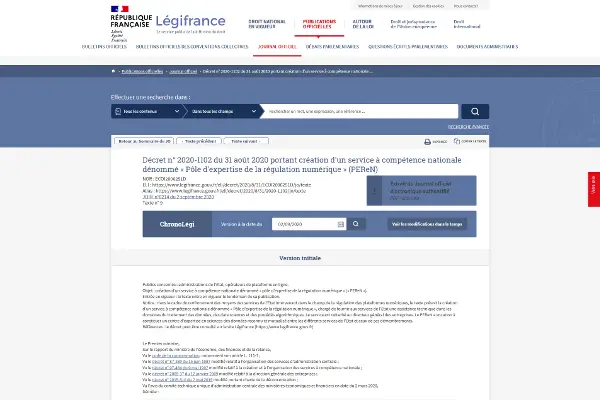
Creation of PEReN
PEReN has been created following the publication of decree n°2020-1102 on the 31 August, 2020. It will be placed under the joint authority of , the Minister of Economy and Finance, , the Minister of Culture, and , the Secretary of State for Digital Affairs.
Published on Aug 25, 2020