Shedding light on…n°9 - « Opening up » social networks: 4 leads in 5 questions
Based on advertising revenues, the economic model of the vast majority of social networks aims to maximize user time. With little control over the technological levers used by users, some are calling for social networks to be "opened up", to "give users back the choice". What impact might this have on users and platforms? This issue 9 of "Shedding light on..." takes stock.

The business model of the vast majority of social networks is based on advertising revenue. This is generated by the time users spend viewing, creating or sharing content. This creates an interest for platforms in their users spending more and more time on the network.
To maximize this usage time, the platforms benefit from three main levers:
- the design of their interface by introducing mechanisms such as infinite threads or notifications;
- the introduction of recommendation systems capable of suggesting ever more new content;
- moderation by seeking to limit the dissemination of content deemed harmful by the platform without being too restrictive.
Large platforms have a great deal of latitude in how to play on these three levers and the legislation on the subject is still limited or recent. If European texts, such as the Digital Services Act or the next Digital Fairness Act, introduce safeguards, the effect on attention mechanisms remains little visible or concrete.
This situation leads some actors or observers to make proposals in favor of an "opening" of social networks to "give users back choice" ("For algorithmic pluralism!", Tribune, Le Monde, 09/25/2024) and allow them to regain control over these levers. Among the ideas put forward are the right to configuration or even a form of interoperability of social network algorithms.
Under what technical conditions are these proposals possible? In this issue 9 of “Shedding light on…”, PEReN offers, in 4 summary sheets, an overview of the possibilities and their impacts on users and platforms.
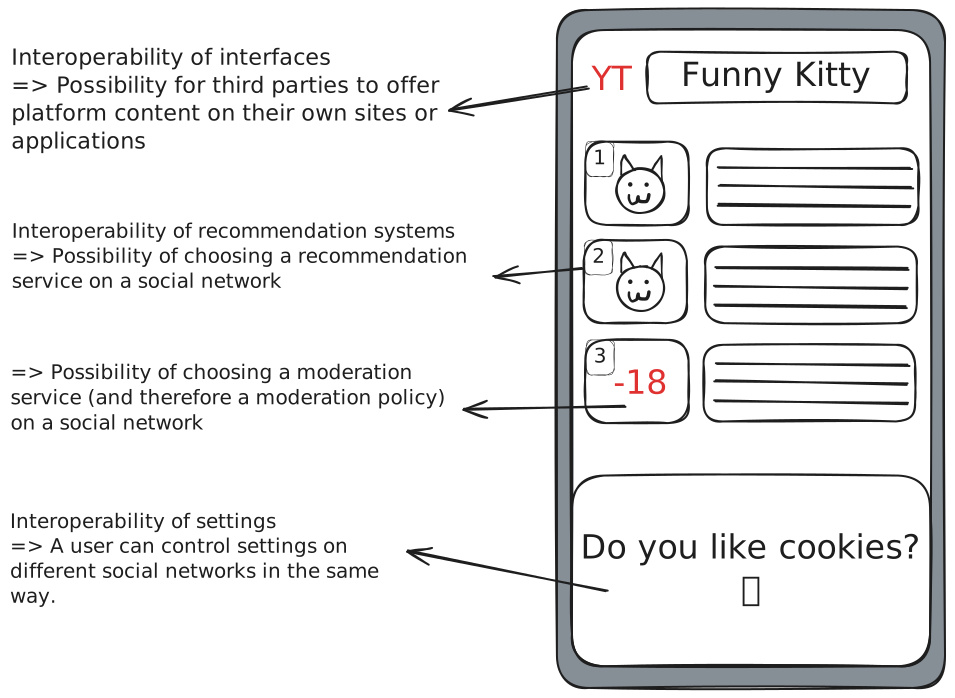
Figure 1: Four interoperability paths to give back “user choice”
While these four interoperability paths are intended to allow users to benefit from a service that is more in line with their uses or expectations, they would nevertheless inevitably be accompanied by constraints for them, particularly in terms of sharing personal data and a more in-depth understanding of how the different algorithmic systems of a platform work. On the platforms’ side, these changes would probably have an impact on their business models and would lead them to reveal certain mechanisms that are currently not very transparent.
The principle
Allowing third parties to offer the content of a platform on their site or application. For example, YouTube or Instagram users could access TikTok videos from their application
What this could solve…
Users could choose a third-party platform that offers a less addictive, more configurable or more suitable interface for their use.
What constraints for platforms?
The platform will have to make available the information of users (activity, profile) who consent to it, but also all of its content to other platforms (typically via an API).
What consequences for the user?
Third-party actors will be able to convince users to choose their interface. We can imagine that to help them in their choice, these actors will be able to provide screenshots of the interface, user reviews or even a simulation of use. If a user is disappointed with their new interface, they can always return to the original product, but will do so at the cost of sharing their data.
What impact on the processing of data, particularly personal data?
In the case of non-public circles (private channels, chat groups) where user content and activity are presumed private, full interoperability would require all members of the circle to consent to the sharing of this information with a third-party platform. Although technically feasible, it seems complicated to easily obtain unanimous consent for relatively large circles. For platforms whose content is predominantly public, third-party actors could see this as an opportunity to obtain the personal and usage data of a significant number of users at low cost. They would in fact obtain usage data without having to host or produce content.
Other issues…
- The original platforms would potentially see all of their public content made available to other actors without being able to oppose it;
- The multiplication of actors could lead to a form of decentralized social network (like the Fediverse) with in particular problems of scale linked to the multiplication of information flows and the replication of data;
- Examples are provided by Twitter, which originally allowed access to content by third-party clients, and by Reddit. In both cases, the platforms ended up refusing third-party clients or imposing prohibitive API access rates, in order to re-establish a direct link with their users and the way in which the content is offered to them (access to more detailed terminal data, control of the interface and the display of advertisements for example).
The principle
Allow the user to choose a recommendation service on a social network other than the one automatically offered by the platform. The recommendation is used in particular to propose exploratory or similar content.
What this could solve…
The user could choose a recommendation system that suits them better with:- configuration possibilities (e.g. choosing preferred themes, excluding others);
- action against the effects of “filter bubbles”;
- limits the presence or number of recommendations generated.
What constraints for platforms?
A high-performance personalized recommendation requires access to the platform’s usage data as well as user profiles. To compete with the systems currently offered on major platforms, the latter would potentially have to share all the data at their disposal with third-party systems, otherwise third parties would not be able to offer recommendations that are as high-performance. Another possible scenario: sharing more aggregated (and therefore less sensitive) data, but this would be to the detriment of the relevance of the recommendations. The platform will also have to make all of its content available.
What are the consequences for the user?
A recommendation system can be complex and difficult to explain:- since the experience offered is personalized, the user will probably need to test the systems before making their choice, at the cost of sharing their personal and usage data with multiple third parties in particular;
- the systems have little interest in being completely transparent about how they work so as not to allow users and content providers to benefit from them by optimizing the content they publish;
- simple models (typically editorialized) will probably be able to more easily explain the interest they hold and convince users.
What impact on the processing of data, particularly personal data?
Interoperability of recommendation systems would potentially lead to significant sharing of sensitive data if third-party platforms have access to all the data used today by systems.
Other issues…
- Recommender systems have only very recently been addressed by regulation. It is objectively technically complex to propose a high-performance model that effectively combats filter bubbles, that does not contain bias or that does not contribute to the circulation of problematic content. The proliferation of recommender systems makes the task of regulation potentially more complex.
- It is likely that popular recommendation offers will be highly editorialized, with the risk of ever deeper segmentation of users and the reinforcement of individual opinions. Similarly, it is likely to observe anti-selection phenomena, the diversity of algorithmic offers leading to a greater polarization of users who group around algorithms that themselves become filter bubbles.
- Attention will have to be paid to the economic model in order not to favor algorithms focused on capturing attention, which would go against the objectives sought, in particular to give users back the ability to choose.
- Very large platforms have huge catalogs of content. The development and deployment of a high-performance recommendation system for such catalogs requires enormous computing power. It is likely that only very large digital players will be able to position themselves in this activity, with economic equations to be found.
The principle
Allowing the user to choose a moderation service (and therefore a policy) on a social network
What this could solve…
The user could choose a moderation policy more suited to their use, offering for example:- a specific offer for children;
- a particular effort on disinformation;
- more configuration parameters.
What constraints for platforms?
The platform will have to open its service to moderation by third parties. The technical integration should be similar to the current case of platforms that already delegate the application of their own moderation policy to service providers. In particular, it will have to provide access to content subject to moderation (publications, comments, media, etc.)
What consequences for the user?
A moderation service will describe its service through the different types of content that it prohibits. These types of content can however be subjective and their identification differ from one service provider to another (for example on disinformation). In fact, as moderation for one user should not be able to impact that of other users, nor in particular be less stringent than legal obligations, this interoperability of moderation would not fully replace a minimal moderation applied by the platform with which it should be articulated. Thus, third-party moderators will only be able to proceed with the additional masking of content not previously deleted. Moderation is also an imperfect service whose precision or effectiveness may depend on the service provider and which should be explained to the user.
What impact on the processing of data, particularly personal data?
Similarly to the case of the interoperability of interfaces, moderation by a third party within the framework of non-public circles would require that all members consent to it, which seems complex to obtain for relatively large groups. For the moderation of public content, the third party will obviously need public data linked to the content to be moderated, such as the content itself, or its title and description for example. But to be truly effective, moderation also relies on data linked to the profile of the creator or that of the users who reacted to it. This is personal data without which third-party moderation could not be entirely effective.
Other issues…
- Estimating the actual distribution of problematic content: contributing to an ever deeper segmentation of user experiences, the interoperability of moderation systems would then make this estimation more difficult.
- Economic balance: moderation is an expensive practice. How can we avoid favoring more lax policies because they are cheaper and capture more attention?
The principle
Allow the user to control the settings (notifications, parental control, personal data, accessibility options, etc.) on different social networks in the same way, typically via a centralized tool.
What this could solve…
The user would no longer need to delve into the settings offers of the different platforms and could apply the same configuration everywhere more simply.
What constraints for the platforms?
For accessibility reasons, the settings format offered by social networks (to control certain aspects of the interface or the recommendation for example) should ideally be standardized, which seems complex given their varied nature. The settings of notifications, for example, are generally done by category (more or less fine) of notifications. It would then be necessary to imagine a categorization that works for a set of platforms.
What consequences for the user?
Gathering the dozens of parameters of each social network in one place, with sometimes different definitions of the same terms, will require an extremely clear interface and strong attention from the user. Large platforms could also be tempted to introduce dark patterns into such a tool. Monitoring of the conditions of use by the tool, and indicated to the user, would be important in this respect.
What impact on the processing of data, particularly personal data?
The impact here is relatively low, but the service that provides interoperable management of parameters will be aware of the platforms on which users have an account, as well as certain choices that it has made.
Other issues…
- We can fear that the platforms will seek to delegate part of their responsibilities to these configuration tools (age verification, activation of parental control, etc.);
- It is not certain that competition between several tools of this type could emerge given their a priori identical functionalities
The PEReN “Spotlight on…” collection offers, in an educational format, technical analysis elements on themes related to the regulation of digital platforms. Find here all the published issues.